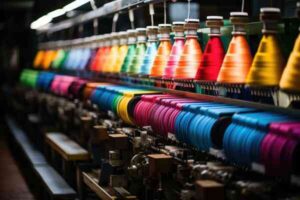
The textile and textile products (TPT) industry is one of the oldest business sectors in Indonesia. It was initially established to meet domestic demand while serving as an import substitution strategy.
Over time, the TPT industry became one of Indonesia’s leading non-oil and gas export sectors to various countries and a key driver of growth in the manufacturing sector.
Covering the production of fibers, yarns, fabrics, garments, and household textiles, the industry has expanded significantly to serve both domestic and international markets, contributing substantially to the national economy.
The textile industry has become one of the main contributors to the manufacturing sector. Textile products rank third among Indonesia’s export commodities. In addition to generating foreign exchange, the textile industry is labor-intensive, absorbing a large workforce, including low-skilled labor.
Historically, the textile industry experienced a golden era as a leading national commodity. However, its growth has fluctuated over time.
Most recently, due to the Covid-19 pandemic in 2020, the TPT industry experienced significant contraction. The impact included reduced production utilization, workforce layoffs, and declining export revenues.
In addition, the industry continues to face various challenges, including domestic issues, global competition, regulatory constraints, and the lingering effects of the pandemic.
Historical Development
Textile activities have long been known in Indonesia. During the kingdom era, textile crafts such as weaving and batik were developed primarily within royal courts for artistic and cultural purposes.
Over time, textiles expanded beyond cultural uses and became a source of livelihood for many communities.
Historical records show that Indonesia’s textile industry began as a home industry around 1929. At that time, weaving and knitting were done using the Textile Inrichting Bandung (TIB) Gethouw loom, better known as the Non-Machine Loom (ATBM), invented by Daalennoord in 1926. Products included traditional textiles such as sarongs, long cloth, lurik, stagen (belts), and shawls.
The ATBM was gradually replaced by the Power Loom (ATM), first used in 1939 in Majalaya, West Java, after electricity became available in 1935. This marked Indonesia’s entry into mechanized textile production.
In the 1960s, textile development intensified under Indonesia’s guided economy system. The government established industry organizations known as OPS (Organizations of Similar Companies), coordinated by GPS Textile (Association of Similar Companies). These organizations were supervised by the Minister of People’s Industry.
By the mid-1960s, these groups merged into OPS Textile, categorized into subsectors such as spinning, weaving, knitting, and finishing.
In 1974, various organizations formed the Indonesian Textile Association (API).
The 1970s marked a revival of Indonesia’s textile industry, driven by Japanese investment in upstream subsectors. Between 1970–1985, the industry expanded, mainly serving the domestic market.
From 1986 onward, the TPT industry grew rapidly due to favorable business conditions and export-oriented policies. During 1986–1997, textile exports increased significantly, making the industry a strategic non-oil export contributor. Ready-made garments became the leading export commodity.
However, the 1998 multidimensional crisis weakened the industry until 2002. Although restructuring efforts followed, challenges such as financing and infrastructure persisted.
In 2007, the government initiated a machinery restructuring program to improve efficiency, competitiveness, and product quality.
Economic Contribution and Structure
According to Statistics Indonesia (BPS), the textile and garment industry contributed Rp127.43 trillion to GDP (constant prices) in 2021. This represented a 4.08% contraction compared to 2020, though better than the 8.88% contraction in 2020.
The national TPT industry consists of:
- Upstream sector: 33 industries (3.31 million tons/year capacity)
- Midstream spinning sector: 294 industries (3.97 million tons/year)
- Weaving, dyeing, printing, finishing: 1,540 large industries and 131,000 SMEs (3.13 million tons/year)
- Downstream garment sector: 2,995 large industries and 407,000 SMEs (2.18 million tons/year)
Factory utilization dropped to 30% in Q2 2020 due to pandemic restrictions but recovered to 80% by the end of 2021.
Employment in the TPT sector increased from 1.7 million workers in 2018 to 3.9 million in 2020.
Investment has also grown, with hundreds of companies investing billions of dollars in expansion and modernization.
Export Performance
Indonesia’s textile exports have fluctuated over the past decade. Export value declined from USD 13 billion in 2018 to USD 5.85 billion in 2020 due to the pandemic, then grew by 17.74% in 2021.
The United States remains the largest export market, followed by Japan, China, South Korea, and Germany. Garments dominate exports compared to other textile products.
Challenges
The Indonesian TPT industry faces at least ten major challenges:
- Limited global competitiveness
- Increasing imports from efficient producers like Bangladesh and Vietnam
- High electricity tariffs
- Annual wage increases and labor disputes
- Aging machinery
- Low productivity and limited technological advancement
- High interest rates
- Complex credit procedures for SMEs
- Infrastructure limitations
- Consumer preference for imported goods
Global challenges include free trade agreements (FTA), dependence on imported raw materials and machinery, currency fluctuations, and global financial crises.
Additional issues include:
- 10% VAT on imported cotton since 2014
- Lack of FTAs with key markets such as Europe and the United States
- Competition from countries with preferential trade agreements
- Energy costs, financing constraints, labor issues, and regulatory challenges
- High coal prices, container shortages, and expensive shipping rates
Toward Industry 4.0
The TPT industry is one of five priority manufacturing sectors under the “Making Indonesia 4.0” roadmap. The goal is for Indonesia to rank among the world’s top five textile producers by 2030.
To achieve this, the industry must adopt digital technologies such as:
- 3D printing
- Automation
- Internet of Things (IoT)
Digital transformation will enhance productivity, quality, and efficiency while building integrated Industry 4.0 textile clusters.
Government Policies
To support the industry, the Ministry of Finance issued safeguard import duties in 2019 for yarn, fabrics, and certain textile products.
Other regulations include:
- Customs procedures for exports (Directorate General of Customs and Excise)
- Revised import regulations for textile and textile products by the Ministry of Trade
The Indonesian textile and textile products industry remains a strategic sector with strong historical roots and significant economic contributions. Despite structural and global challenges, ongoing modernization, policy support, and digital transformation are expected to strengthen its competitiveness and sustainability in the future.